Foreign policy priorities and powerful
interests oftentimes play out in the media (1). Broadly speaking, from the
selection of news stories to the particular angles they may take, the U.S.
media’s account of foreign events can give readers an interesting glimpse into the
interests of America’s powerful. It is no coincidence that media attention
focuses much more on matters that relate directly to U.S. national and
corporate interests even though similar events around the world go
underreported. Four case studies—the protests in Ukraine, Venezuela, the West
Bank, and Thailand—help demonstrate this relationship.

By a wide margin, the mass anti- and
pro-government protests and accompanying political crisis in Ukraine have received
a majority of the news coverage. Dozens have been killed and pictures
of fires and violence from the protests have gone viral. While many may know of
Ukraine only for its Chernobyl nuclear disaster, the former Soviet satellite
has vast geostrategic importance to the United States. The U.S. has given over
$3 billion to Ukraine since its independence in 1991, mostly for pro-market
reforms and strengthening civil and political institutions. The billions of
dollars in aid are intended to help orient Ukraine away from Russian influence through
economic and political alignment with the West. Since 1995, Ukraine has also
been in consultation with NATO to explore the possibility of membership. These
developments have in part helped shape the current media portrayal of
anti-government demonstrations there as a kind of post-Cold War tug-a-war
between Western and Russian influences, since the now-disposed prime minister
made an eleventh-hour rejection of talks with the European Union over Ukraine’s
possible membership, a decision that became the very spark of current unrest.
Indeed there are decades of economic, political and military interests at play
between the West, Ukraine and Russia, and the media’s reporting has certainly
reflected this.
Venezuela
Venezuelan protests, too, have found their
way onto the media’s main stage—or at least its orchestra section. Mass
demonstrations erupted two weeks ago with grievances including rampant crime,
high inflation, food shortages and general economic stagnation over the past 15
years. The country’s oil wealth and proximity to the United States add to the
media’s interest in Venezuelan protests, however the two countries have a
bitter history. Under Hugo Chavez’s presidency, the Venezuelan leader was not
shy about his disdain for the United States and particularly its leaders. He
and current President Nicolas Maduro have both blamed the U.S. for
demonstrations against their leaderships, most recently when President Maduro
accused the C.I.A. of attempting a coup. The story is only now beginning to
reach a mass audience.
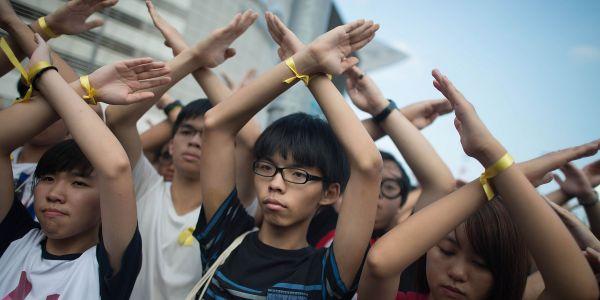
Thailand
Obtaining moderate news coverage is the

steady flow of demonstrators since protests first gripped Thailand back in
November 2013. As I’ve written before,
the mostly-peaceful protests have occasionally turned violent by unknown
assailants. Just this past weekend, a bomb killed four people—three of them
children—during an anti-government protest in Bangkok. On Sunday, 34 people
were wounded and one girl killed by gunmen who open fired on demonstrators.
Political leaders on all sides have signaled to their constituents to
eliminate violence while those in power see their legitimacy evaporating in the
eyes of thousands of demonstrators. Despite the fact that Thailand is party to
the Southeast Asian Treaty Organization (SEATO)—a security pact signed by
Thailand, the United States and six other nations—bilateral relations with the
U.S. are generally poor. One of the biggest points of contention are the food
subsidies given to American farmers by the federal government, which are seen
as giving growers an unfair price advantage, especially in the rice market.
While not a perfect comparison, Thailand's current political crisis is not too
different from Ukraine’s, the only crucial difference being Ukraine’s higher geostrategic
value to the West.
West
Bank
While Israeli-Palestinians peace talks are
at the heart of the Obama Administration’s Middle East policy, scant media
coverage has been attributed to a demonstration of a different flavor that embodies one obstacle to peace: “thousands”
(2) of Israeli youth joined protesters gathered in the West Bank city of Ma’ale
to protest the freeze on construction of new settlements in the contested E-1
region. On the surface, the gathering was a one-day affair. Scores assembled in
the city to show solidarity with and support for Jewish settlements in the West
Bank during peace talks that would—if ever ‘successfully’ concluded—probably
require the transfer of some settler lands to Palestinian ownership. What makes
the gathering significant is the fact that members of Israeli Prime Minister
Netanyahu’s own Cabinet attended the rally and that the international community
roundly condemns Israel’s settlement expansion and points to it as the number one impediment to peace. The
crowd’s zeal to promote the settler movement coupled with high-profile
government supporters in attendance throws doubt on how acceptable a peace deal
would be to the Israeli public and political spheres. Highlighting these bits in
the U.S. media wouldn’t be good for the dimming hope surrounding the talks.
_______________________________
(1) Edward
Herman, and Noam Chomsky, Manufactured Consent: The Political Economy
of the Mass Media, (New York: Pantheon Books, 1988).
(2) Israel’s Haaretz news
publication. Note that the youth gathering in the West Bank was almost entirely
ignored by the American media.