Tuesday, July 1, 2014

Part 2: From Anbar to Aleppo and Back Again

The most recent violence in Iraq did not appear suddenly, as if from nowhere. It’s been brewing since the US troop withdrawal in 2011, and was established during the US occupation, as discussed in Part I of this essay series. The insurgency’s fires have been flamed by the civil war that has been raging in Syria for roughly the same period of time. The conflict’s regional extension is the topic of Part 2 of my essay series on the increasingly likely Iraqi civil war.

Part 2: From Anbar to Aleppo and Back Again

ISIS may have been born in Iraq, but it came of age in Syria. Founded in 2003 as a branch of Al Qaeda in Iraq (AQI) dedicated to combatting the US occupation of Iraq, the Islamic State in Iraq was one of many AQI-led terrorist groups that carried out attacks against both foreign forces and the newly elected Iraqi government of Nouri Al-Maliki during the civil war of 2006-2007. The group has long operated out of Al-Anbar province, while receiving aid and fighters from Syrian provinces across the border, where tribal connections run deeper than national boundaries. Despite a lull in attacks during the US surge, ISI operations began to ramp up as troop withdrawals began in 2009. The civilian death toll in Iraq has only continued to climb and each year reaches new, morbid heights:


And then came Syria. Already the launching ground and regrouping point for ISI attacks in Iraq, the rapid disintegration of government power in Syria provided the perfect vacuum for the group to step in and claim to join those fighting for freedom. At the same time as the final US troops withdrew from Iraq in 2011, Syria was descending into a civil war that would eventually act as a magnet for extremist groups including ISI, all of whom wanted a piece of the post-war spoils. The Islamic State in Iraq quickly transformed into the Islamic State in Iraq and al-Sham (or “and Syria,” or “and the Levant”) to denote its expanded mission, and has now declared its name as simply “Islamic State,” indicating its goal of creating a caliphate that spans the Muslim world. In July 2012, ISI declared the “Breaking of the Walls” campaign, which culminated with over 500 militants freed in a prison break from the infamous Abu Ghraib outside Baghdad in July 2013. It broke off from Al Qaeda in January 2014, when arguments among the leadership over tactics and strategy apparently caused an irreparable rift.

Friday, June 20, 2014

Part One: The Road Back to Baghdad

Three years after the American withdrawal from Iraq, the broken country we left behind has reared its ugly head and threatens to descend into sectarian civil war. In many ways, the United States is reaping the seeds it sowed in the manner of its exit from Iraq as well as our nearly total non-involvement in Syria’s civil war next door. The road back to Baghdad has been coming for the US ever since we withdrew from the country in 2011 (and, arguable, ever since we waged an uncoordinated mess of an invasion and occupation in 2003). 

Part one of this essay delves into what many have taken to calling “The Iraq We Left Behind,” and possible US strategies to address some of these issues. Part two will discuss the interconnected Syrian conflict’s ramifications in Iraq, and address the question of whether or not Iraq (or any of Syria’s neighbors) will find stability if civil war continues to rage next door. Part three will discuss the US opportunities to eek some good out of this international and regional disaster, especially with longtime adversary Iran.

---------------------------------------------------------------------------------------
 Part One: The Road Back to Baghdad


Central in the story of Iraq’s re-descent into civil war (if, arguably, it ever left it), Prime Minister Nouri Al-Maliki looms as both villain and longtime partner. Allegedly selected for the Prime Minister post in a shadowy dealing between a CIA officer and the US Ambassador in Baghdad, Zalmay Khalilzad, Maliki went from being a relatively unknown but zealous activist in the pro-Shi’ite movement to Prime Minister of Iraq in three months’ time in 2006. Having fled Iraq after his political activities on behalf of the Shi’ite Dawa Party (now his political party) threatened to get him killed, Maliki directed anti-Saddam operations from abroad until the US invaded in 2003. According to Khalilzad in an article by Dexter Filkins, the US only exerted its influence in Iraq to help the election come to the result it wanted. Although American officials had been assured Maliki was "independent" from Iran, it became apparent that he was closer to the Islamic Republic than informants had admitted, and it is now rumored he was hand-picked by the Iranian Al Quds commander Qassem Suleimani. Yet from sideline supporter, America's relationship with Maliki grew in the coming years until the US openly supported Maliki in the subsequent 2010 elections against his secular opponent, Ayad Allawi.


Wednesday, June 4, 2014

Obama’s Foreign Policy (or “Lack Thereof”?)

My colleague Colin Wolfgang recently addressed the perceived shortcomings in Pres. Obama’s foreign policy, many of which speak to legitimate concerns. He suggests that the Obama administrations failures on foreign policy have not come from policy itself, but a lack of clear vision for America’s position in world affairs. Yet in doing so, he uttered a telling phrase about Obama’s “inability to project American dominance on the rest of the world in the same way his predecessors have done before him.” This history of American power projection and its detrimental effect on America’s credibility, coupled with the changing nature of the global balance of power, have resulted in the Obama administration’s current perceived inability to negotiate a better position for the United States. The administration’s policies, however, reflect both the wishes of the American citizenry and a new paradigm in international relations, one that places primacy not on power but on peace, not on the winning of wars but the avoidance of war by other means.

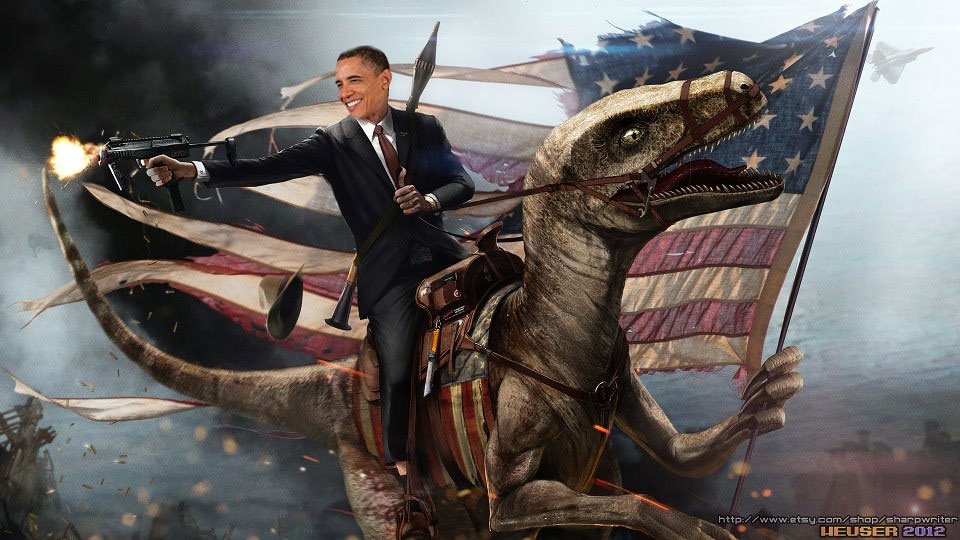
Pres. Obama riding a velociraptor. Because reasons.
 As he took office in January 2009, Pres. Obama was faced with a global financial crisis largely brought on by the policies of prior administrations, two unpopular and unsuccessful wars in the Middle East, and an increasing threat of Islamic extremism throughout the world. Despite these obstacles, for many observers Pres. Obama’s first term was a success in terms of his foreign policy initiatives, and foreign policy was considered one of his strengths vis-à-vis Mitt Romney in the 2012 election. He oversaw the final withdrawal of US troops from Iraq, established a timeline to wind down the Afghan war, attempted to close down Guantanamo Bay, and pursued a policy of limited drone warfare against terrorist groups. As his second term dawned, however, increasing political violence in Iraq clouded the success of troop withdrawal, a political stalemate with the Afghan government hindered the creation of a comprehensive transition plan, Guantanamo remained open (and still does), and the policy of drone warfare came under fire as the civilians affected by drones as well as drone operators spoke out about the program’s human costs.

Friday, May 30, 2014

Obama's Foreign Policy (Or Lack Thereof)

In his commencement speech at West Point on Wednesday, President Obama addressed much of the criticism that has been thrown his way recently regarding his inability to project American dominance on the rest of the world in the same way his predecessors have done before him. Most people would agree that Obama has been leery of armed conflict since taking office in 2009, and justifiably so, after the two costly wars former President Bush thrust the U.S. into in the early 2000s. And certainly in certain contexts, isolationism can be an overarching framework that helps shape a country's foreign policy decisions - one has to look no further than the United States leading up to the Second World War, after World War I left such an awful taste in its mouth. However, President Obama has not used isolationism as his foreign policy framework; rather, he has no framework. And as his tenure as Commander in Chief winds down over the next few years, it's that very lack of framework that will come to haunt his legacy, and possibly set the global political arena on a path the United States will wish it had avoided.

Getty Images


Tuesday, May 27, 2014

Elections? What Elections?

Recycled leaders: Political cartoon depicts the cycle from
Mubarak to Morsi and now to al-Sisi
Two days into the Egyptian presidential elections, voter turnout is so low that Prime Minister Ibrahim Mehleb declared today a national holiday. Voter enthusiasm is wan, dissidents have been locked up in the tens of thousands, and no one seems to doubt what the outcome of this “election” will be. Former Defense Minister Abdel al-Sisi will almost certainly emerge victorious, both because he controls the state-run propaganda machine of the media, and because he has locked up, tortured, or disappeared all those who would be powerful enough to stand against him. In the seventh vote or referendum since Egypt’s revolution of 2011, it appears that the country is no closer to democracy than when it began the process of casting off authoritarian rule.

Al-Sisi’s only opponent in the election is left-wing Nasserist Hamdeen Sabahi. Sabahi ran in the 2012 presidential elections and came in third, but is viewed as mere window dressing to give the elections the air of democracy. Even though Sabahi’s chances of victory are next to nothing, campaign workers have nonetheless reported being blocked from polling stations, and prominent lawyer Ahmed Hanafi Abu Zaid was brutally beaten and arrested in a dispute with another campaign worker.