Showing posts with label Iraq. Show all posts

Wednesday, February 18, 2015

Apocalypse Now: Islamic State's Real Strategic Goal

Forty-five people burned alive in western Iraq. Twenty-one Egyptian Coptic Christians beheaded by the sea in Libya. Five Western aid workers and journalists executed, one Jordanian pilot incinerated, and two possibly related terrorist attacks in Western Cities. All in addition to the tens of thousands  of victims killed or forced into displacement by fighting in northern Syria and Iraq. If Islamic State is seeking to bring about signs of End Times, they are doing a pretty good job. Increasingly, policymakers are forced to take seriously the Islamic State’s self-declared mission: to bring about the Day of Judgment by sowing chaos in the world in the lead-up to the return of the Mahdi.

The Four Horsemen of the Apocalypse ride Toyotas, who knew?
The only thing more terrifying than a power-hungry Islamic State that uses scripture as a pretext for brutality is one that actually believes in it. While Al Qaeda’s stated goals were largely ones of retribution against the West and its allies for perceived injuries to the Muslim-majority world, the Islamic State's doctrine has confounded policymakers due to its seemingly earnest belief that the apocalypse – and thus paradise for true believers – is at hand, and indeed can be pushed along by worldly deeds. Drawing upon Koranic texts that suggest the End Times will be signified by a battle between the armies of “Islam” and “Rome” in northern Syria (in the town Dabiq, which Islamic State already controls and has named its journal after), the Islamic State strategy of directly goading the United States into intervening in Syria and Iraq becomes much more rational. By drawing the US into battle, Islamic State would have its “Army of Rome.” And defeat of this army is just the first phase of the apocalypse.

Monday, September 15, 2014

Obama’s Foreign Policy: A Legacy of Interventionism

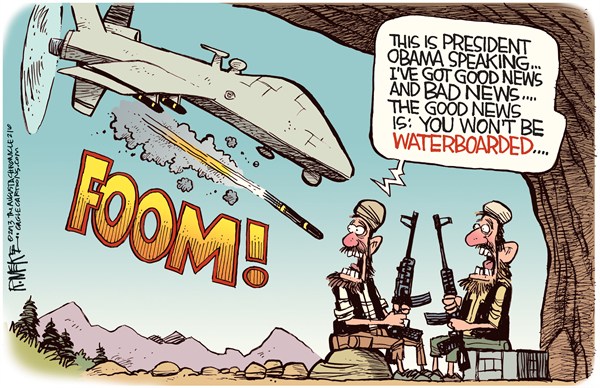
My colleague Colin Wolfgang recently wrote about Pres. Obama’s speech last Wednesday, in which the president announced that US airstrikes would extend from Iraq into Syria to combat the growing threat of the terrorist group ISIS(/IS/ISIL/who-cares-what-they-call-themselves-they’re-nuts). While many, including Mr. Wolfgang, point to the speech as a turning point in the Obama administration away from isolationism, it in fact continues the Obama White House foreign policy that has been in place since he took office: namely, Pres. Obama’s policy of small- to medium-scale military intervention by another name.


Whether you call it “police action,” “counterterrorism,” “targeted airstrikes,” or any of the other Obama administration euphemisms, this White House has pursued interventionist tactics in almost every global hotspot where it has encountered national security threats. The supposed difference from the George W. Bush administration has been the absence of “boots on the ground,” despite the fact that there will now be nearly 2,000 American “advisors” and who-knows-how-many special operations and CIA agents in Iraq. While large-scale military operations such as the Bush-era wars in Iraq and Afghanistan have been wound down, the United States is far from an isolationist nation.

Monday, August 18, 2014

Rewriting History in the Middle East: The Yazidis [No Longer] in Iraq

State borders in the Middle East have been in flux for millennia, with the strongest ruler of the day vying for control over fertile land, trade routes, and major water sources. Today, the region is populated with many countries whose modern-day borders were arbitrarily delineated by the British-French Sykes-Picot Agreement, whose peoples have been in a constant struggle to reclaim what they believe is rightfully their land. Much of a state’s validity comes from being able to show that they have the oldest claim to the region, so what happens when a people’s physical life, when their physical history is deleted?


What happens when a city is blown to smithereens by explosive charges, as with mosques and churches in Mosul, instead of falling to salvageable ruins? What happens when an entire people is removed from their ancestral homeland, fleeing to a neighboring country, leaving no trace of their existence in the former land? Or, in the grand scheme of political and strategic interests, is the individual human story irrelevant?

Friday, August 8, 2014

The Road Back to Baghdad Part 3: The Reckoning

Early this morning US time, two 500-pound, laser-guided bombs were dropped by US forces on Islamic State (IS) targets outside of Erbil, Iraq. Overnight, the Obama administration shifted its policy of non-military intervention in the ever-expanding conflict with the Islamic State, citing both humanitarian and strategic concerns. Since June 2014, Islamic State has made several alarming advances in Iraq and Syria, claiming major cities such as Fallujah, Ramadi, and Mosul, and re-engaging Syrian government and rebel forces across the border.

Islamic State positions. Courtesy NY Times.
The capture of key territory in both countries has reinforced the extremist group’s financial and military resources, and in IS strongholds, a strict form of Islamic law is being enforced. The US airstrikes come on the heels of the displacement of tens of thousands of Yazidi Iraqis, whose religion has been deemed “devil worship” by IS and who were warned to “convert or die.” In his statement last night, US Pres. Barack Obama indicated that the decision to expand humanitarian and military aid was based on fears that “acts of genocide” may soon be carried out against Iraqi Yazidis, approximately 40,000 of whom are trapped without food or water on Sinjar Mountain in Kurdish Iraq.

Wednesday, July 16, 2014

Have Neocons Finally Learned Their Lesson?

Just over ten years ago, the United States was beginning what would be two lengthy military campaigns in the Middle East. On one hand, in Afghanistan, intelligence suggested that the Taliban had been supporting Osama bin Laden and the al-Qaeda network, effectively abetting in their attack on the World Trade Center. On the other hand, in Iraq, less-reliable intelligence suggested the presence of WMDs, and it was decided that while securing these weapons, the U.S. should depose the violent dictator who had ruled the country for decades, Saddam Hussein.

In both cases, eventually, neocons suggested that these campaigns were, more broadly, necessary evils in order to preserve democracy and promote American interests abroad. There was an outpour of this type of justification as the death tolls and monetary costs continued to grow, and while popular support gradually waned, Americans begrudgingly accepted these justifications as truths.

Today, American watches as Iraq implodes, with the militant faction ISIS inching ever closer towards Baghdad as the government scrambles to establish a more inclusive parliament that represents the interests of the complex array of sects and ethnicities that make up the constituency.


And in Afghanistan, what appeared to be a promising democratic election threatened to erupt into chaos when the results were dismissed as illegitimate, and both leading candidates declared themselves the rightful winner. It appears that Secretary of State John Kerry has for the time being successfully ameliorated the tension, but a stable, legitimate government still seems a long ways off.

Tuesday, July 1, 2014

Part 2: From Anbar to Aleppo and Back Again

The most recent violence in Iraq did not appear suddenly, as if from nowhere. It’s been brewing since the US troop withdrawal in 2011, and was established during the US occupation, as discussed in Part I of this essay series. The insurgency’s fires have been flamed by the civil war that has been raging in Syria for roughly the same period of time. The conflict’s regional extension is the topic of Part 2 of my essay series on the increasingly likely Iraqi civil war.

Part 2: From Anbar to Aleppo and Back Again

ISIS may have been born in Iraq, but it came of age in Syria. Founded in 2003 as a branch of Al Qaeda in Iraq (AQI) dedicated to combatting the US occupation of Iraq, the Islamic State in Iraq was one of many AQI-led terrorist groups that carried out attacks against both foreign forces and the newly elected Iraqi government of Nouri Al-Maliki during the civil war of 2006-2007. The group has long operated out of Al-Anbar province, while receiving aid and fighters from Syrian provinces across the border, where tribal connections run deeper than national boundaries. Despite a lull in attacks during the US surge, ISI operations began to ramp up as troop withdrawals began in 2009. The civilian death toll in Iraq has only continued to climb and each year reaches new, morbid heights:


And then came Syria. Already the launching ground and regrouping point for ISI attacks in Iraq, the rapid disintegration of government power in Syria provided the perfect vacuum for the group to step in and claim to join those fighting for freedom. At the same time as the final US troops withdrew from Iraq in 2011, Syria was descending into a civil war that would eventually act as a magnet for extremist groups including ISI, all of whom wanted a piece of the post-war spoils. The Islamic State in Iraq quickly transformed into the Islamic State in Iraq and al-Sham (or “and Syria,” or “and the Levant”) to denote its expanded mission, and has now declared its name as simply “Islamic State,” indicating its goal of creating a caliphate that spans the Muslim world. In July 2012, ISI declared the “Breaking of the Walls” campaign, which culminated with over 500 militants freed in a prison break from the infamous Abu Ghraib outside Baghdad in July 2013. It broke off from Al Qaeda in January 2014, when arguments among the leadership over tactics and strategy apparently caused an irreparable rift.

Friday, June 20, 2014

Part One: The Road Back to Baghdad

Three years after the American withdrawal from Iraq, the broken country we left behind has reared its ugly head and threatens to descend into sectarian civil war. In many ways, the United States is reaping the seeds it sowed in the manner of its exit from Iraq as well as our nearly total non-involvement in Syria’s civil war next door. The road back to Baghdad has been coming for the US ever since we withdrew from the country in 2011 (and, arguable, ever since we waged an uncoordinated mess of an invasion and occupation in 2003). 

Part one of this essay delves into what many have taken to calling “The Iraq We Left Behind,” and possible US strategies to address some of these issues. Part two will discuss the interconnected Syrian conflict’s ramifications in Iraq, and address the question of whether or not Iraq (or any of Syria’s neighbors) will find stability if civil war continues to rage next door. Part three will discuss the US opportunities to eek some good out of this international and regional disaster, especially with longtime adversary Iran.

---------------------------------------------------------------------------------------
 Part One: The Road Back to Baghdad


Central in the story of Iraq’s re-descent into civil war (if, arguably, it ever left it), Prime Minister Nouri Al-Maliki looms as both villain and longtime partner. Allegedly selected for the Prime Minister post in a shadowy dealing between a CIA officer and the US Ambassador in Baghdad, Zalmay Khalilzad, Maliki went from being a relatively unknown but zealous activist in the pro-Shi’ite movement to Prime Minister of Iraq in three months’ time in 2006. Having fled Iraq after his political activities on behalf of the Shi’ite Dawa Party (now his political party) threatened to get him killed, Maliki directed anti-Saddam operations from abroad until the US invaded in 2003. According to Khalilzad in an article by Dexter Filkins, the US only exerted its influence in Iraq to help the election come to the result it wanted. Although American officials had been assured Maliki was "independent" from Iran, it became apparent that he was closer to the Islamic Republic than informants had admitted, and it is now rumored he was hand-picked by the Iranian Al Quds commander Qassem Suleimani. Yet from sideline supporter, America's relationship with Maliki grew in the coming years until the US openly supported Maliki in the subsequent 2010 elections against his secular opponent, Ayad Allawi.


Wednesday, April 16, 2014

The Ones the World Forgot: The Syrian Refugee Crisis

The following is an adaptation of a presentation I gave on April 12, 2014 at the Boston Consortium for Arab Region Studies conference:

Since last writing on this topic in February, the news emanating from the Syrian refugee crisis has only gotten worse. There are now close to 2.7 million refugees who have fled the Syrian conflict, the majority of whom have settled in Iraq, Turkey, Lebanon, and Jordan. There are almost 14 million people who are in need of aid in the region as a result of the conflict, and funds from the international community have hardly been forthcoming: the UNHCR’s appeal for 4.2 billion dollars is only 14% funded, while UNICEF’s 222 million dollar appeal is less than 12% funded. Without these desperately needed resources, UN agencies as well as over one hundred other humanitarian agencies can do little to mitigate the devastating effects of the Syrian conflict on the region.

The effects of the crisis on Syria’s neighbors are becoming more acute, and more violent. In Lebanon, clashes not only in the north of the country but also in Beirut have led to scores of casualties and deaths. A Syrian refugee mother recently set herself on fire in front of a UN building in Tripoli because she was unable to feed her four children on the small amount that aid agencies and the government are currently struggling to provide. Lebanon also passed the “devastating milestone” of one million Syrian refugees this month, and refugees now make up a quarter of the population, the largest per capita concentration of refugees in the world.

Friday, October 4, 2013

Iraq: The Middle East’s Ticking Time Bomb

On December 18, 2011, Iraqis watched in mixed fear and jubilation as the last US tanks rolled across the border into Kuwait, marking an official end to the American-led invasion in 2003. Two years later in 2013, those fears seem to have borne out while jubilation is in short supply: civilian deaths are reaching levels not seen since the Iraqi civil war of 2007-2009, and massive attacks have become a regular facet of everyday life. In September alone, there were nearly 1,000 deaths, 800 of which were civilians. Even this was shy of the 2013 high of 1,057 deaths in July. Sectarian, regional, and tribal divides have widened, not subsided, and the Maliki government itself is a hotbed of corruption, poor governance, and has lost the public’s faith as a democratic institution. The current path of Iraq indicates at best a pattern of cyclical violence, and at worst a nearly unstoppable march back to civil war.

Qasim Ahmad Tahan carries the body of his 5-year-old son Walid.
Courtesy AP.
Yet chances are, you haven’t seen Iraq in the headlines in a while. Violent acts have become so frequent that they hardly make it on Twitter reports. On Monday alone, 15 car bombs went off in Baghdad, which, as the BBC’s Michael Knights points out, “would have been an unprecedented event...[i]n any other country.” In Iraq, it was the 38th attack of this kind in the last 12 months. Given that the current security crisis began but did not end with the US occupation of 2003-2011, American policymakers should be scrambling to figure out a way to aid the Maliki government in combatting the violence. With a civil war next door in Syria and unrest in Egypt, instability is spreading like disease throughout the region in the wake of the Arab Awakening’s derailing by autocrats. Combined with US war weariness with Iraq itself, it appears that the US can or will do little to stem the tide of what is becoming a river of blood.

Tuesday, July 23, 2013

What the Heck is Going on in Iraq?


In the 19 months since the Obama Administration effectively removed the last of the U.S. troops in Iraq, the embattled state has seen slight progress – something virtually unparalleled since Saddam Hussein was taken out of power in 2003. Due to enormous, and previously unforeseen deposits of oil underneath Kurdish territory in the north and northeast regions of the country, Iraqi Kurds have had more leverage in dealing and negotiating with Prime Minister Nouri al-Maliki’s Shiite government – in fact, this past June marked the first time al-Maliki had visited Iraqi Kurdistan in over two years. On the other hand, sectarian violence, especially between the Sunnis and the Shiites, has remained incredibly high. For his part, al-Maliki has “encouraged talks”, but with a promise to continue military assaults against Sunnis he perceives as threatening, these talks are likely not to happen anytime soon. However, there certainly remains an air of increasing stability in the country – an air that has not existed in quite some time.

Saturday, March 30, 2013

The Future of Global Energy

We've often heard the familiar warnings that the world's natural resources dwindle year after year, inching humanity closer to a point of no return. Damage to earth's forests, oceans and atmosphere, however, may not be enough to persuade policymakers to take bold steps toward cleaner, alternative energy sources and carbon emission reductions goals. Such steps shape global energy markets and trends, as does energy diversification, supply and demand. Unpredictable events, such as the Fukushima nuclear disaster, can also mold the energy markets of the future. Thus, it is critical to examine the various moving parts involved in world energy markets in order to accurately assess the future of these markets.

A few characteristics of global energy markets give some context for what we should expect in the future. The rise and fall of energy prices have ripple effects across other energy and energy-related industries. OECD countries, including  the United States, are demanding less and less oil, while burgeoning economies in East Asia see an increase in demand for petroleum that drives an expected overall increase in global demand for oil in the coming decades. Countries such as China and Germany are heavily subsidizing solar power, and new technologies in wind and solar could enable more efficient harnessing of these energy sources. And finally, much of the predictions for the future of global energy markets depend on two critical points: bringing Iraq's vast oil reserves online and the potential of unconventional oil and gas extraction (by fracking, for example), especially in the United States.

Monday, March 11, 2013

Syria Brief: UN Peacekeeper Hostages

On Saturday, and after three days of detention by factional elements of the Syrian opposition called the Martyrs of Yarmouk, twenty-one UN peacekeepers were released into Jordan just six miles from their captivity in Jamla. UN Secretary General and other officials have demanded the release of the filipino peacekeepers, who serve in the broader UN Disengagement and Observer Force (UNDOF). UNDOF serves as the peacekeeping mission to monitor a demilitarized zone along the Golan Heights, which Israel acquired from Syria following the 1967 war. While the militants claim that the peacekeepers were "guests" and that they were just escorting the blue helmets to safety from an area under attack from government forces, the Martyrs of Yarmouk and their seemingly random capture and transport of UN peacekeepers have raised serious concerns about the radical elements within the Syrian opposition and whether or not they can be reigned in by the opposition. 


Chief of Staff greets the 21 peacekeepers in Amman after 
safely crossing the Jordan border. Jordan Pix via Getty Images.

Tuesday, February 19, 2013

Syria is Burning: The Devastating Effects of Nonintervention


I have a Syrian friend named Ahmed, a kind and friendly owner of a local cafe in Allston. As I'm grabbing my morning coffee, Ahmed and I talk politics often as he knows my interest in international relations focuses mainly on the Middle East. In our four years of friendship, he's offered some of the most astute and accurate observations of Middle Eastern politics I've ever heard. I remember a conversation we had early last summer that began as most of our conversations do, with me asking how his family still in Syria was doing. With his characteristic smile and cheerful demeanor, he dismissed my concerns. "They all live in Aleppo," he said. "The regime could never afford to touch Aleppo. That's where all of the rich and powerful people live."

Aleppo in October 2012.

Fast-forward eight months to today and much of Aleppo is a burned out shell, reflecting the desperate situation across all of Syria. Since the end of the Eid al-Adha “ceasefire” in late October, fighting has ramped up along with casualties, compounded by a harsh winter faced by civilians who have in many cases lost everything. In a conflict that has left at least 70,000 people dead, 2 million internally displaced, and 700,000 refugees, the frontlines have stagnated throughout much of the country, leading to fears of a drawn out and devastating war of attrition. Since the uprising began in March 2011, Western governments have contented themselves with tentative UN moves handily blocked by Russia and China. Regional powers support whichever side serves their interests, and competing factions within Syria’s neighbors oftentimes arm both.