Thursday, November 29, 2012

Palestinian Sovereignty: Revisited

Today marks the 65th anniversary of the U.N. General Assembly's decision to divide the Palestinian state into two separate states - one Arab, one Jewish. The historical significance of this is not lost on many: just about two weeks after the beginning of an eight-day Israeli foray into Gaza, the U.N. General Assembly will vote imminently on whether or not to grant Palestine the title of a "non-member observer state", a significant upgrade for the territory. Two weeks ago, I would have said that there was no way the motion would pass at the U.N.G.A. amidst all the violence in the region. However, it appears that Israel's hostile aggression won Palestine the support of many previously neutral states, notably those in Europe.

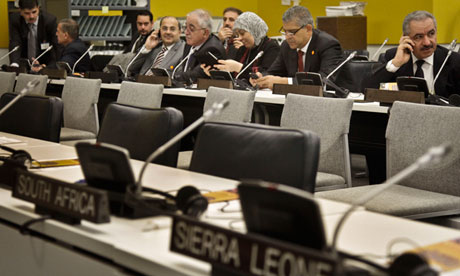
Palestinian delegation today at the U.N.

The United States and Israel continue to vehemently oppose this historic and dramatic change. Israeli Prime Minister Benjamin Netanyahu was quoted as saying "The decision at the United Nations will change nothing on the ground. It will not advance the establishment of a Palestinian state. It will delay it further." Obviously, he is displeased.

Mr. Netanyahu is being silly though. Of course this decision will change the situation on the ground; it will also expedite the two-state peace process which has seen nothing but endless quagmires for decades. Israel's enemy is not necessarily Palestine these days, but rather Hamas, the violent Islamic organization that has significant control over the Palestinian territory. In fact, Israel immediately claimed responsibility after killing the military commander (the intended target) of Hamas in an airstrike, prompting the eight days of violence that ensued last week. But if anything, what this decision will do for Palestine is diminish the authority Hamas has over the "non-member observer state", and increase the authority that Fatah, the "official" governing organization has. President Abbas of Fatah is committed to garnering support for a two-state peace process and will continue to be emphatic in this regard. As for the seemingly endless missiles fired from Palestinian territory into Israel, there will be greater accountability now. Legitimizing Palestine will put them under increased pressure from the international community, and increased scrutiny if cross-border tensions continue.

Really, Israel and the United States should be voting alongside what appears to be the overwhelming majority of the U.N.G.A. who will vote in favor of upgrading Palestine's status in the U.N. In my opinion, it will be a crucial step forward - a step closer to the two-state peace that has long been sought after not just by Israel and Palestine, but by the rest of the world as well.

Monday, November 26, 2012

The Israel-Hamas Ceasefire: Not with a Bang but a Whimper


It looked like a nightmare dreamt too many times: Israel assassinates top Hamas leader, Hamas increases rocket fire, Israel threatens a ground incursion, and a US-Egyptian brokered ceasefire is reached, and in the interim people's lives were lost. To many, the latest conflict between Gaza and Tel Aviv offers a story told time and time again with much the same result. The biggest losers were certainly the Gazans and Israelis who lost their lives – 158 and 3 respectively – while for the most part, Hamas’s objectives have been achieved, as have those of the Israeli government. Yet for all the news coverage hailing the end to fighting, has anything really changed?

A rocket is destroyed by Iron Dome. Photo by Emanuel Yellin.

Outside observers have already called into question Israel’s decision to assassinate Mahmoud Jabari at this particular moment, with explanations ranging from pure dumb luck to a political calculation by the ruling Likud party. Assassinating Jabari when a long-term ceasefire was reportedly close at hand (and may have been, in fact, in his hands) risked the fragile peace process, enflamed radical factions, and created a leadership vacuum. Whoever his successor is will need a long time to gain the support and popularity necessary to convince Gazans to maintain any future ceasefires. Jabari was a figure who could negotiate both with extremists within his own party and those without; his political capital cannot be replaced in a short period of time and, in many ways, his death will actually hurt Israel’s ability to implement a peace agreement.

Many have posited that Binyamin Netanyahu used the assassination to look “tough on Gaza” in the face of the upcoming Israeli elections in January. Such allegations cannot be discounted entirely, but this was hardly the first time an assassination attempt was made on Jabari, who had been targeted in and survived four previous attacks. Operation Pillar of Defense was publicly popular in Israel, but Netanyahu may have been wisest in deciding not to opt for a ground operation that would not have received such wide support. His government also avoided the internationally unpopular civilian casualties that marked the last Gaza conflict, Operation Cast Lead, indicating that the point of Pillar of Defense was not to militarily overwhelm Gaza. More likely is the assertion that this was not a true conflict but a testing ground. Israel managed to test the efficacy of the Iron Dome short-range missile defense system (90 percent of targeted missiles were successfully destroyed) while at the same time measuring the amount of support other governments could and would lend to Hamas if a serious escalation with, say, Iran were to take place. It also tested the United States and other Western countries’ reactions at a time when the Israeli government is thought to have severely damaged ties with Barack Obama’s U.S. government. That the West in large part came out in support of Israel’s right to self-defense was a welcome diplomatic signal in Tel Aviv.

IDF poster distributed in the West

Iran was likely the main spectator Israel hoped to impress with its weapons and defense capabilities, support from the West, and willingness to take military action when provoked. A conflict over Iran’s nuclear weapons program has been mounting for months, and Israel had to ensure that if and when a war comes, it can defend itself from attacks launched from Iran as well as Lebanon and Gaza. While the Iron Dome system proved itself capable of deterring a short-range attack from Gaza, it is telling that the Israeli government’s attention is now on the creation of David’s Sling, a medium- to long-range missile defense system that would primarily protect it against attacks from Lebanon or Iran. Now that the near enemy has been subdued, questions of attacks from afar have once again become Israel’s primary concern.

Much like the Israeli government, Hamas emerged from the latest conflict with clear victories both domestically and abroad. A longstanding issue (recently covered by Zach) has been the challenge to Hamas from within Gaza by other, oftentimes more militant groups like Islamic Jihad. Hamas stands in a precarious position in Gaza: in order to keep the peace it must stop rocket attacks both by itself and other groups, but in order to maintain popular support it cannot afford to look “soft on Israel.” In other words, it wants to avoid the problems experienced by Fatah when the group began policing other militant organizations. Hamas cannot put an end to rocket attacks by opposition groups without risking domestic condemnation; nor can it risk not firing rockets of its own and handing the popularity garnered by such attacks to its rivals. The solution for Hamas was to launch rockets, but largely at sites like fields where no civilian casualties were likely.

Throughout Operation Pillar of Defense, Hamas managed to look as though it successfully stood up to Israel and achieved its goals, all the while not risking its diplomatic standing with the West and other Arab governments. The ceasefire provides for its three main goals: an end to the conflict, a halt to incursions and assassinations, and increased ability of movement for people and goods. Victory rallies throughout Gaza upon news of the ceasefire illustrated that the Gazan public views this latest conflict as a win for Hamas. The separation of celebrants into different groups according to political affiliation, however, demonstrates that obstacles remain to Hamas’s unilateral control of the Gaza Strip.

Hamas also used the conflict as a testing ground for its new pivot away from its former Iranian and Syrian allies and towards Egypt, Qatar, and Turkey. Relations with Syria have significantly deteriorated as Hamas has disavowed the beleaguered President Bashar al-Asad, and with them the relationship with Iran has been dealt a blow as well. The flood of Arab envoys that visited Gaza indicated the tilt towards the other side of the “Middle Eastern Cold War:” Turkey, Egypt, and Qatar will assume ever-growing important roles in the mediation of the Israeli-Palestinian conflict.

The clear loser in this conflict, aside from the civilians who lost their lives, was Fatah and Mahmoud Abbas. Although the West Bank leader persists in his campaign for non-member status at the UN, his organization’s image among Palestinians and the world community continues to wane. Palestinians are disillusioned and disenchanted with his policy of diplomatic recognition, which many no longer believe will lead to a viable statehood for Palestine. That Fatah was barely given a seat at the negotiating table for the ceasefire talks also shows that the international community has noted its diminished significance in all things Palestine. In the future, it is Hamas, not Fatah, which will represent Palestinians on the world stage. Only by finding a way to reconcile with Hamas will Abbas’s party avoid fading away into oblivion.


Top: A Gazan home following an Israeli strike
Bottom: An Israeli home following a rocket attack

Egypt was the final major player in the Israel-Gaza conflict and newly elected president Mohammed Morsi revealed himself to be adept at maintaining dove policies while projecting a more popular hawkish image to the Arab world. His policies did not stray in substance from Hosni Mubarak’s: he pursued a rapid conclusion that would avoid further Egyptian entanglement in a messy conflict. While his rhetoric was much stronger than that of his predecessor, his actions proved to be in the same vein as Mubarak’s. His concern is keeping the calm within Egypt. Given the massive security (Sinai) and economic (a deficit in the billions of dollars) problems his government faces, Morsi served his own interests in brokering the ceasefire while increasing his domestic and international prestige. The intent and effects of his power grab immediately after the ceasefire was announced remain to be seen.

On the surface, the most recent Israel-Gaza encounter appears to have changed little in the overall Arab-Israeli conflict. Yet Israel may still see a long sought-after decrease in rocket attacks, weapons smuggling, and Islamist militancy. Hamas has already received promises that its people will move more freely and safely across Gaza’s borders. Egypt’s new government has proved itself capable of weathering a regional storm. Fatah has been pushed even further to the sidelines in Palestine. The key issues now will be implementation of the ceasefire, the continuation of peace talks towards a long-term solution, and maintenance of the tenuous calm that has been reached in the south. For the sake of Israelis and Gazans alike, the ceasefire must hold but be recognized as a temporary solution for which there needs to be a long-term replacement.
Tuesday, November 20, 2012

The Plague of Eastern Europe


As I wrote about last Wednesday and my colleague Zach wrote about yesterday, the conflict between Israel and Palestine continues to occupy international media, especially with the threat of a ground attack coming from Israel in upcoming days. With any luck, the proposed cease-fire aimed to go into place tonight will do just that, and Gaza and the West Bank can experience a calming peace tomorrow this time.

Despite the importance of this conflict, the rest of the world continues to be, more or less, business as usual. The glaring exception to this is former Croatian Prime Minister Ivo Sanader, who will not be doing any more business (at least for the next ten years). Mr. Sanader was sentenced to ten years in prison today for taking bribes - estimated in the tens of millions of dollars - once in the 1990s and once in the late 2000s, both times from energy companies. Mr. Sanader's plight, unfortunately, is not uncommon: corruption amongst officials in government, in police forces and even the judicial systems has been one of the most significant problems Eastern European countries have had to face in recent years, usurping Communism's influence several decades ago.

Corruption is no secret when it comes to countries such as Bulgaria, Romania, and others. It is estimated that the vast majority of officials - judges, police officers, and government officials - in both countries have at the very least accepted small bribes or somehow illegally used their influence to sway policy and skirt national law. While some countries, such as the Ukraine, have stepped up immensely in combatting such corruption, others are overwhelmed. Corruption over the years becomes so deeply rooted within a country that it ends up being virtually impossible to weed it all out without destabilizing the country economically and politically.

Mr. Sanader at his sentencing.

Some argue that membership into the European Union is the best remedy for corruption, but even this has its drawbacks. For starters, the European Union doesn't want the problem of corruption to be added to the already myriad problems they are faced with today. But for those corrupt states that are already members, certain setbacks for anti-corruption come with membership: the European Union brings with it increasingly open borders which allow for less transparency, and the ability to do business off the books more easily within one's country as well as others. This can be enticing for those most corrupt, and the spillover corruption into other countries could very possibly devastate the European Union. At a time when their finances are already in such disarray, this is a very serious threat they will take into consideration when approving new members.

One of those new members is Croatia. Slated to join the European Union in July of next year, Mr. Sanader's sentencing will hopefully set an example for current and future leadership in not just Croatia, but in the rest of Eastern Europe. Corruption is without a doubt an insidious, debilitating plague that will need to be confronted head on within the next decade once the European Union has the time and the energy. Otherwise, they will be stuck with murky finances, useless judicial systems convicting the wrong people (or worse, no one at all), and governments that are difficult to work with - talk about a real nightmare.


Monday, November 19, 2012

Operation Pillar of Defense - Policy Brief

Five days ago, Israeli officials authorized aerial and naval strikes on Gaza in response to 12 years of persistent rocket fire from various militant groups in the Gaza Strip. An offensive policy billed as a defensive one, Operation Pillar of Defense (or Pillar of Cloud with the religious connotation) is a strong reaction to what Israel views as terrorist attacks for which Hamas is responsible. Since the first day of the operation marked by the assassination of Ahmed Jabari--Hamas' military chief--over 900 rockets (and rising) have crossed into Israeli territory at all ranges. Recent rocket strikes on or near Tel Aviv, Jerusalem and continued strikes on border cities and other population centers such as Be'er Sheva demonstrate the imperative of a cease-fire agreement. Additionally, an estimated 1,500 to 2,000 Israeli troops are stationed near the Israeli-Gazan border in apparent preparation for a ground operation, which Israel has stated it is ready to undertake. To this end, officials have already approved recruiting up to 70,000 reservists for the potential ground operation. Just this morning, the IDF asserted it has attacked 1,350 targets in Gaza since the beginning of the operation.

For Gaza, the operation looms as a recurring occupation in an environment the UN recently stated in a report will be unlivable by 2020. Also important is the fact that Hamas, the militant Islamic group that controls Gaza, has been a controversial player as it's frequently accused of having ties to Iran, dragging the region into chaos and proving unaccountable to the people that elected it to power in 2006. The unfolding events occur during a period of historic change in the Middle East while instability in nearly all of Israel's surrounding countries pose unique challenges and opportunities: sectarian clashes in Lebanon, civil war in Syria, protests in Jordan, security concerns in the Sinai and now mounting terrorist activity in Gaza. 

In the midst of all of this, Operation Pillar of Defense stands to reinforce the changing status quo in the Middle East and is the partial biproduct of Israeli political and strategic considerations. Other forces informed the authorization of the operation as well, and together the evidence paints a complex web of interconnected events that is shifting, and is some cases, deteriorating. Below are some important developments and paradigms that are shaping events on the ground and provide clarity to the situation ahead.

Poster tweeted by @IDFSpokesperson 

Context of Operation Pillar of Defense

Gaza

Within the past month, rocket-fire from Gaza to Israel has escalated. The IDF and Israeli government have repeatedly emphasized this as being the major reason for launching Operation Pillar of Defense.  Israel has grown increasingly wary of the weaponry entering Gaza, citing Iranian influence. For example, it has also been widely suspected that Israel was behind an attack on a Sudanese munitions factory in October, which Israel says was going to transport weapons to militants in Gaza. Although Hamas remains the administrative authority in Gaza, it has struggled to reign in other militant factions operating there. There are a handful of militant groups operating in Gaza at the moment, including Hamas, Islamic Jihad, the popular resistance committees and even a few 'Jihadi Salafist' groups.[1] This power struggle may exacerbate because of the assassination of Ahmed Jabari or failure of Hamas and Israel to come to a cease-fire agreement. Another factor that complicates a cease-fire agreement and provides Israel the impetus for its operation is that fact that despite that a majority of the rockets are launched by other militant groups, Israel sees Hamas as responsible. Other concerns are the youth bulge (51% of Gaza's population under 18) and high youth unemployment in Gaza that embody the prime agents of change yet simultaneously the main audience for terrorist recruitment.

Cease-Fires and Distrust

Cease-fires in the past have been hard to forge and even harder to implement between Israel and Hamas. The high level of mutual distrust doesn't help. Recent events demonstrate this diplomatic roadblock. On the morning of Ahmed Jabari's assassination by surgical aerial strike, Jabari had been given a copy of a cease-fire in the works. While the assassination was a huge political success for Prime Minister Netanyahu and for the operation, Hamas sees the developments as Israel's insincere efforts to come to a cease-fire in favor of targeted killings and a military operation bent on Hamas' destruction. For Israel, it is dealing with a terrorist organization that has reneged on its promises before and suspects Hamas will do more of the same. The mutual distrust between Israel and Hamas remains an impasse to peace, which might require foreign involvement to overcome.

Israeli Domestic Politics

For some, Operation Pillar of Defense started off looking a lot like Israel's 2008/2009 Operation Cast Lead, although there are important differences. The most obvious parallels are that both operations are against Gaza and both occur before elections. For Prime Minister Netanyahu, public support remains very high, which will obviously help the Likud-led coalition in the early elections in January. Until the public's exuberance wears off, Operation Pillar of Defense will remain a huge PR victory for the current ruling coalition. Indeed, any move Israeli officials make could affect election results.

Shifting Regional Balance of Power

The Arab uprisings of 2011 onward unexpectedly shook the region into upheaval. Hundreds of thousands of people took to the streets to demand (except for in a few Gulf states) the overthrow of their oppressive authoritarian governments. Most important to Israel were the developments in Egypt and Syria, especially with regard to the Syrian civil war agitating sectarian fault lines in Lebanon and spilling into the Golan Heights. Israel has long relied on Egypt's peace treaty with the former as a lynchpin of regional stability. Now with President Morsi of the Muslim Brotherhood and it's Freedom and Justice Party in power, the reliability of this lynchpin is questioned. Recent flare-ups of violence in the Sinai peninsula speak to the waning stability there. In Syria, President Asad clings to power as the opposition looks for international legitimacy and arms supplies. The situation in Syria has recently spilled into the Golan Heights, prompting light Israeli retaliation. With military engagements emerging from multiple fronts, Israel will have to weigh its military operations carefully.

A second important dimension of the shifting regional balance of power focuses on the axis of Iranian influence in the region. The Iran-Syria-Hizballah-Hamas nexus is one of Israel's top concerns, exacerbated by reports that Iran has signalled further uranium enrichment. Recent developments, however, have diffused some parts of this threat considerably. As Iran continues to enrich uranium and supply arms to Gaza, it's allies across the Middle East are fragmented. Syria is completely engulfed in civil war. In Lebanon, support for the Syrian government runs along sectarian lines, and the resulting clashes show no sign of letting up. As a political actor there, Hizballah sits in paralysis. Subsequently, Hamas has avoided taking sides in the Syrian civil war, which has hurt its reputation among old friends Syria and Iran. All of this points to an eroding bloc in the balance of power, especially now since Israel is facilitating this change via Operation Pillar of Defense.

Egypt and the United States Weigh In

The Obama administration's position on the Israeli military operation is supportive, with Congress showing it's support as well. President Obama's biggest concern is the civilian death toll, especially in Gaza. Rising civilian casualties in Gaza not only bring the conduct of the IDF into question but also threatens America's image in the Middle East depending on how the U.S. responds to the violence. President Obama will most likely make it his first priority to both support Israel's right to self-defense yet also project concern for the Palestinians to the governments in the region. As evidenced from President Obama's 2009 speech in Cairo, his administration is looking to reposition itself in the Middle East and forge new ties to the region. In this sense, President Obama should actively engage the current situation in Gaza in order to exemplify his mission, and the Middle East needs strong American involvement at a time like this.

Egypt's interest in the conflict is hardly surprising given its geographic, historic and ideological connections to Gaza and Hamas, and it's peace agreement with Israel. In addition, Egypt has added incentive to help broker a cease-fire agreement given the deteriorating security conditions in the Sinai. A diplomatic achievement by President Morsi would also shore up support at home. Thus for all of these reasons, Egypt might prove to be an essential player in the cease-fire negotiations and implementation.

A Final Note

The day after Operation Pillar of Defense began, Palestinians across the West Bank and Gaza celebrated 'Palestine Independence Day,' which commemorates the Palestinian National Council's proclamation of an 'independent Palestinian state' on that day in 1988. Right now at the UN General Assembly, President Abbas of the Palestinian Authority is pressing for UN 'non-member state' status for Palestine, a turn of events that Israeli officials considered obstructing. It is curious that Operation Pillar of Defense was launched during a symbolic and important time for the Palestinian people. And as evidenced above, Israel's decision to retaliate comes during a multidimensional juncture and is, therefore, at least partially informed by national, regional and global implications. As shown through the above analysis, the statement "Israel's Operation Pillar of Defense is in response to terrorist attacks and reflect Israel's right to defend itself" becomes a misleading, simplistic diagnosis for a complex reality.

Perhaps the most dangerous part of the recent conflict is not the current fluid situation on the ground but the question of the aftermath: who or what will emerge from the rubble in Gaza? In many ways, Hamas poses a unique challenge to Israel, but it may be the least of Israel's problems in Gaza.

______

[1] Khaled Hroub, "Salafi Formations in Palestine and the Limits of a De-Palestinised Milieu,"Holy Land Studies 7, no. 2 (2008), 164


A special thanks to my sister, Erin, who is currently in medical school in Be'er Sheva, for her running commentary on the recent developments and insights. I would also like to thank her boyfriend Nevo and his family for taking care of her during this unstable time. Our thoughts and prayers are with you! Stay safe!

Wednesday, November 14, 2012

The Hamas Militant Leader is Dead...Now What?

EDIT 11:35am: This article from BBC published today refers to an internal position piece Israeli Foreign Minister Lieberman describing a unilateral effort by Israel to "topple" Palestinian President Abbas should the Palestinian bid at the U.N. for non-member state status be approved. Has the "toppling" process already begun?

It was reported earlier today that Israel had killed the leader of the militant wing of Hamas, the Palestinian governing party, a major milestone for Israel and a major setback for Palestine. Shin Bet, the Israeli domestic intelligence agency, claimed responsibility for airstrike that killed Ahmed Al-Jaabari, the Hamas leader. Considering the length and severity of the bellicosity between Israel and Palestine, this is seen as a significant military triumph for Israel. However, the repercussions for both sides are enormous - with the tumultuous landscape all over the Middle East right now, there has never been a more dangerous brink of war between the two.


Of course, Israel and Palestine have had military engagement in the past. In 2008 and 2009, shelling across the border over the course of three weeks resulted in almost 1,500 deaths between the two. Since then, there have been virtually ceaseless smaller conflicts and disagreements that keep the two pitted against one another: most notably (and disconcerting) was an episode this past August in which several Israeli children - the youngest was a 13-year-old girl - viciously beat a group of Palestinian children in a crowded square, so badly that one of the Palestinians was taken to the hospital unconscious. Police reports indicated that many Israelis stood around the altercation simply watching, while the authorities were not once alerted.


Hamas has seen a slight advantage in the past year or so as President Morsi and his Muslim Brotherhood party have taken office in neighboring Egypt. Sharing extreme Islamic views and opinions, Hamas has been able to rely on Egypt as an ally to some degree, further alienating Israel in its already precarious situation in the Middle East. However, Egypt has been pushing towards a truce between the two in past months, and seemed close to producing some results as recently as a few weeks ago.

Egypt's efforts, it appears, will not be fruitful. Hamas has already called for retaliation on Israel, and will have no shortage of support from Palestinian citizens. It is unclear what role the U.S. will play in this, but given his recent re-election, President Obama will surely be engaging the two in productive dialogue as soon as possible in an effort to calm the brewing storm. With Israel having shelled Syria in retaliation for cross-border violence in the past several days, and the ongoing tensions between the U.S. and Iran, the last thing President Obama and Secretary Clinton need is a conflict to erupt in Israel, thrusting the entire region into a violent tailspin. For now, it is too soon to tell, but Israel has symbolically thrown down the gauntlet, and now Hamas will be looking to follow suit.